Saturday, December 31, 2005

One down, eleven to go (Pug 12 Step)


"I don't believe it," Rex said on his first morning of his extended visit to New Orleans.

We had just watched the little black pug vacuum down his 1/3 cup of dry dog food for breakfast.

Nero doesn't eat like other dogs.

He attacks every meal as though he hasn't had one in weeks and doesn't expect to get another anytime soon. He buries his entire face in the bottom of his bowl. It's a fully physical effort that apparently requires heavy breathing, guttural grunting and full use of his compact muscles.

I had warned Rex about Nero before the trip. I had told him about the constant begging when anything is being prepared in the kitchen. About the incessant floor licking, an eternal search for the tiniest morsel of nutrition that might have dropped from a plate. And about the rummaging through garbage of any kind.

But like Thomas in the Upper Room, Rex had trouble believing.

He concocted an experiment that, on the surface, seemed simple and harmless. We would keep giving Nero food until he stopped eating, at which point his "addiction" would be proven to have a limit. In the process, the experience might actually cure Nero of some of his obsession.

I told him it wouldn't work. Nero would just eat until the point of sickness, or organ failure.

Which brings us to Friday night. Rex decided it was time for the experiment. He filled a medium sized mixing bowl with dog food and put it beside Nero's feeding tray. The pug went wild.

We watched. Nero ate. We watched some more. Nero kept eating. Sometimes he would pull his head out of the bowl to chew. At one point he moved about a foot and a half away from the bowl, sat down and stared at the food in apparent confusion.
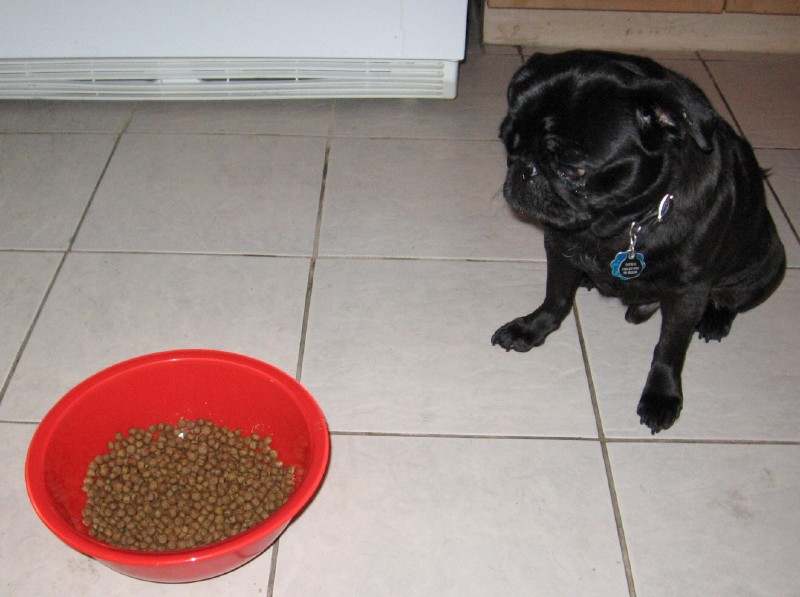
An amazing 15 minutes after the experiment began, Nero had finally had his fill, consuming 10 times his normal meal quantity. His chest and upper stomach were bloated. His eyes were slightly glassy. His movements were deliberate.

"It worked!" Rex exclaimed in triumph.

I still wasn't sure we had accomplished anything other than adding a couple of inches to Nero's waistline.

We all went to bed wondering what would happen next.

Nero's sleep was restless. I woke several times to find him pacing the floor for a minute or two then returning to his bed. His breathing also seemed accelerated but, otherwise, he showed no signs of stress.

We woke in the morning to discover that Rex's experiment wasn't over. There was one more thing to do, he explained. We had to give Nero his normal bowl of food to see if the spell really had been broken.

I protested. Only hours earlier, Nero had eaten enough for the next week. Couldn't this end? Apparently not.

Rex scooped a regular serving of food into the pug's bowl and Nero raced for the meal. Then something amazing happened. Instead of shoving his face into the pellets, Nero pulled his head back and stepped away from the bowl.

He seemed as surprised as we were. The standoff lasted about half a minute. Then Nero slowly approached the bowl again and took a bite. He chewed slowly for a moment, then took another bite. Two minutes later the bowl was empty.

Was his momentary pause a sign of some mental reprogramming? Has his obsession abated, even a small amount?

I'm not sure at this point. But Nero does seem more sedate today. And he hasn't licked the floor once.

Thursday, December 29, 2005

Art, Used Cars and Trailer Trash

There's a set of railroad tracks flanked by empty lots about two blocks from where I live. One of the lots is Nero's favorite poo spot. Before Kartina, the tree line along that lot was a well used illegal dumping ground for locals.

It wasn't unusual during a morning walk with the little black pug to discover a newly discarded item or two flung into the brush, maybe even a bulging black trash bag.

After Katrina, the area became one of many "official" unofficial trash heaps. I even dumped a pile of garden debris and flooded stuff from the garage onto one of the piles. We really had no choice. For more than a month, there was no streetside trash pickup. Hauling waste to the tracks was the only way to keep the stuff from stinking up the fronts of our houses.

The big piles have disappeared, but every few days new items show up again. I discovered the above pile while driving to work this week. I imagine it could be the creation of one of the eccentric artists who populate the Bywater neighborhood where I live. It spoke to me.

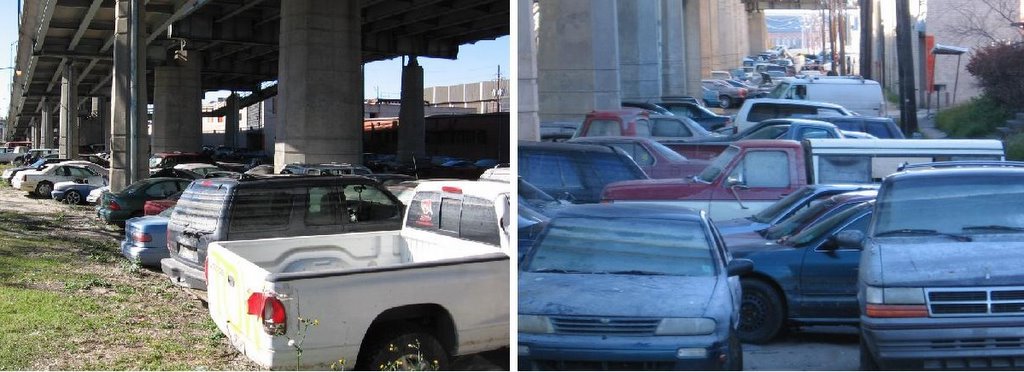
No art here. This is the scene below the Broad Street overpass next to my office. This space used to be overflow parking for newspaper employees. It's become a graveyard for flooded wrecks (note the water lines on the windows). Sometimes, some of the cars disappear. But within a few days, the lot is full again. Who knows when it will end.

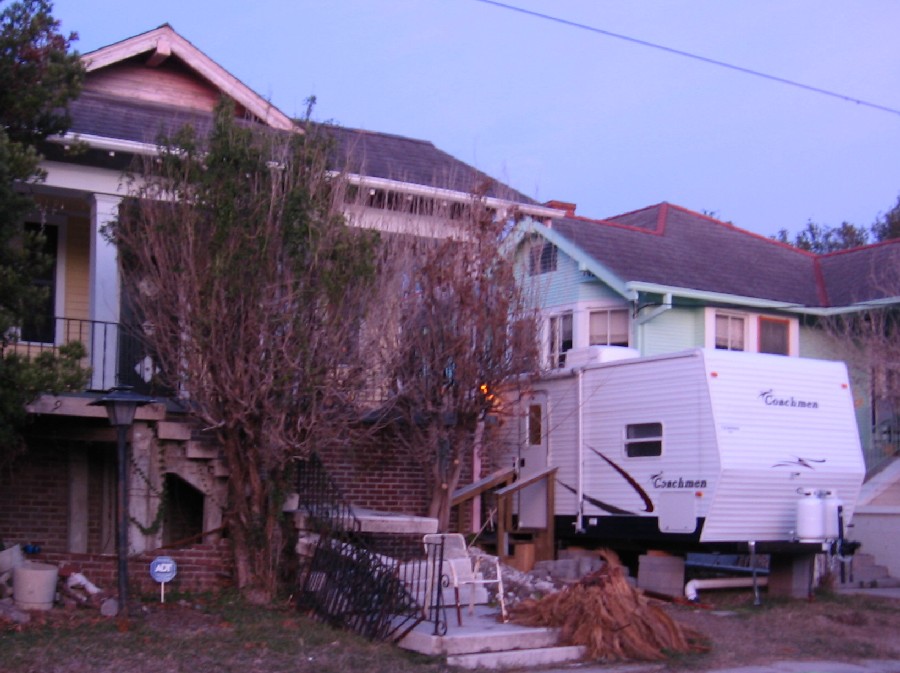
I drove a few blocks through the Fontainebleau neighborhood near the center of the city the other day and counted more than 20 FEMA trailers, such as this one, in front of houses.

Not so long ago, I would have hurled at the sight of a trailer in a historic neighborhood. But the spread of mobile homes is heartening. They're a sign of change after months of stagnation, a signal that people finally are coming back to flooded sections of the city. Welcome to New Orleans - the nation's biggest trailer park!

Sunday, December 25, 2005

Deep Fried Christmas

My family Christmas meal began last week with a hellish trip by Rex and me into the deepest bowels of New Orleans suburbia to purchase a Cajun Flip-N-Fry for $14. We bought the south Louisiana cooking novelty from a woman in her Kenner garage. "You're lucky. This is my last one," she said.

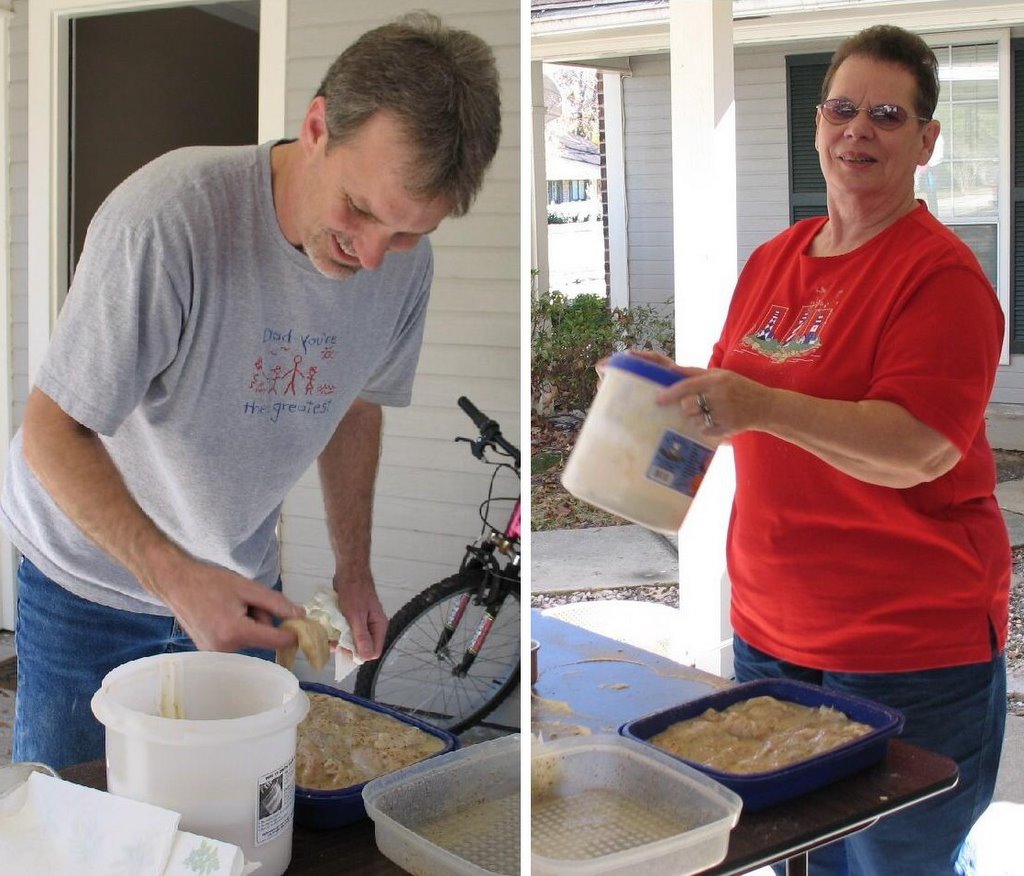
Brother-in-law and Mom use the latest Cajun technology to coat catfish fingers for our not-so-traditional holiday meal.

My sister had called earlier in the week with instructions to buy the device, saying my brother-in-law needed it to coat catfish for our Christmas family lunch at their house.

I got back into the car and handed the Flip-N-Fry to Rex. He stared at it briefly. "This is a piece of Tupperware," he exclaimed in disbelief as he opened the lid of the translucent container and pulled out a perforated plastic divider. "This is Cajun technology?" he asked.

Yes, Rex, it is. Just like the Cajun Injector, an oversized syringe used to fill large pieces of meat with spicy juices. And the Cajun ChickCAN, a metal rack that positions a can of beer (or any other favorite canned beverage) in the "butt" of a chicken for "the most flavorful, moist" grilling experience ever, or so the manufacturer claims. Then there's Boudreaux's Butt Paste, no explanation needed.

Amazingly, the Flip-N-Fry seems to live up to its billing. My brother-in-law said he would have used five times more cornmeal for the Christmas catfish had he coated the pieces the old-fashioned way.

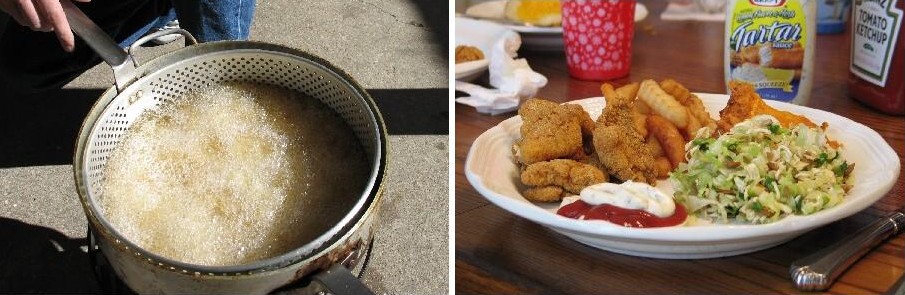
Catfish frying on the driveway, and the final result with fixings.

Joining the catfish on the table were baked potatoes, French fries, Asian cole slaw, corn and crawfish casserole, rolls and cheesecake for dessert.

Of course, south Louisianians are known for nontraditional holiday meals. Think of deep-fried turkeys and turduckens. My family hasn't had a typical Anglo Christmas meal in years. Usually, my brother-in-law makes a big pot of chicken and sausage gumbo, sided by potato salad and corn on the cob.

But this year's lunch likely stretched the limits of acceptable holiday cuisine ... even for these parts.

Wednesday, December 21, 2005

México en el Calle Borbón


How about a tamale or a fish taco to go with your Pat O'Brien's Hurricane or Big Ass beer?

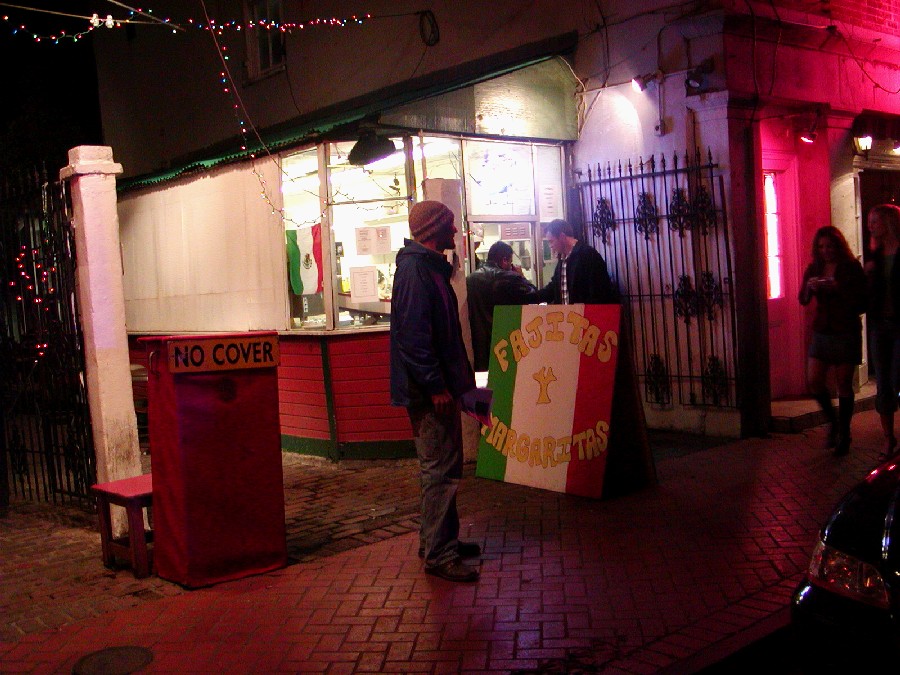
Welcome to Fajitas y Margaritas, one of the newest tenants to move onto Bourbon Street after Hurricane K. Located in the heart of the French Quarter, the sidewalk kitchen is just a couple of doors down from Big Daddy's, the strip club best known for the pair of mannequin legs swinging from the front window.

I discovered this joint Wednesday night during a two-hour stroll up and down Bourbon Street.

You can't find a Lucky Dog cart selling hot dogs on Bourbon Street to save your life, but an $8 burrito is just around the corner.

Ethnic food, outside of pseudo-Cajun cuisine stereotyped to the hilt for the most indiscriminating tourist palate, has been traditionally hard to find along New Orleans' main tourist strip. That makes Fajitas y Margaritas all the more remarkable.

At the very least, the shop boldly declares the arrival of the city's newest immigrant population.

Tuesday, December 13, 2005

Gay life in N.O.

How many gay men does it take to keep a Bourbon Street bar open? Well, as Rex and I found out late Sunday night, not nearly as many as you might think. The crowds were fairly small everywhere we went - Cafe Lafitte's in Exile, The Pub, Good Friends and Rawhide. But that's not so unusual for December, traditionally the slowest month for convention business.

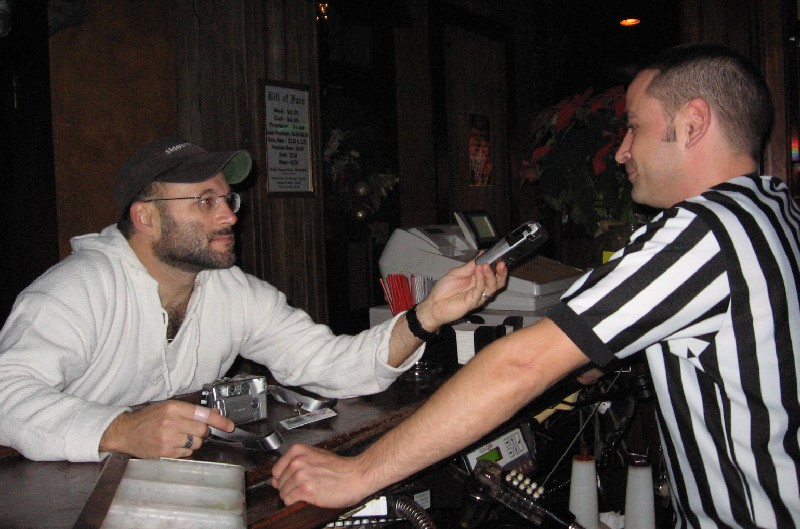
Rex did interviews with bartenders for a story that he's working on about the resurrection of gay and lesbian life in the Big Easy. If there was a universal theme in the interviews, it was this: government workers and contractors now filling the bulk of the city's hotel rooms don't spend nearly as much money on watered-down, overpriced beverages as do tourists.

Saturday, December 10, 2005

Lowa Nint Wawd

The neighborhood worst-hit by Hurricane K lived up to its billing, and then some.

After more than eight weeks back at home in New Orleans, we ventured for the first time into the Lower 9th Ward Saturday afternoon. We crossed the Industrial Canal just a few blocks from my house in the Bywater neighborhood then turned north.

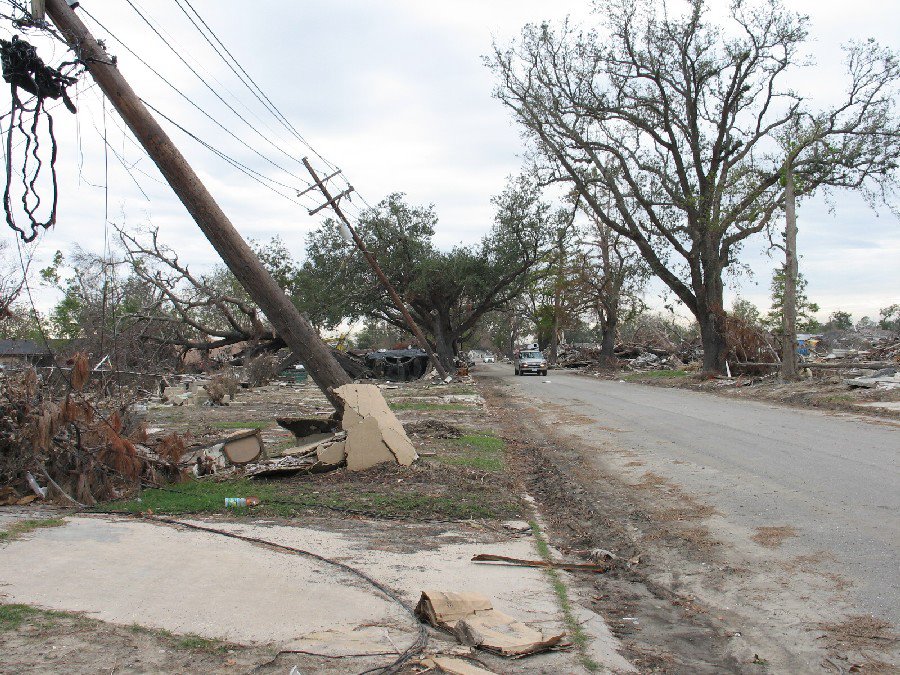
Before long, we were in the middle of a vast wasteland stretching more than 100 city blocks in all directions. Everywhere we looked were empty foundations where houses once stood, cars tossed around like toys, towering piles of rubble and a ubiquitous blanket of gray dried mud.

More than three months after the storm, the only signs of life there were the other catastrophe tourists cruising the area and a handful of people sifting through the wreckage of their homes.

We got an up-close look at the mammoth barge that rested on the neighborhood side of the levee after floating through the barrier during the early hours of Katrina.

I expected things to be bad, but the reality was beyond imagination. I won't be making a return trip anytime soon.

Top pic: The force of the flood water from the Industrial Canal (off camera about four blocks to the right) pushed everything in its path the other way, creating a vertigo effect along some streets.

Sunday, December 04, 2005

Where's Anderson Cooper when you need him?

I spent Sunday morning second-lining down Esplanade Avenue to St. Anna's Episcopal Church with fellow parishioners and visiting priests and parishioners from about half a dozen other Episcopal churches outside of Louisiana. Leading the procession were the Storyville Stompers who reunited several weeks ago and began playing gigs again. A jazz mass followed at the church.

The visitors kept repeating throughout the weekend that the vast scope of damage in the flooded areas of the city was beyond anything they perceived through television and newspaper reports back home.

That's the same response that Rex gave a few days ago when I took him riding through the Lakeview neighborhood near the 17th Street Canal breach. He was stunned.
I've grown surprisingly accustomed to the reaction.

It's sort of like telling visitors they can carry cups of their favorite alcoholic beverage in the street without fear of police intervention. To them, it's an unbelievable privilege not enjoyed at home. To us New Orlenians, it's normal.

That's kind of how it feels now to live a few blocks from the Dead Zone. What shocks the visitor is just life in New Orleans to the rest of us.

Tuesday, November 22, 2005

Welcome to Baghdad, USA

Four overnight power outages in two weeks. One morning without water. A day and a half without cable television and high-speed Internet service. Periodic whiffs of natural gas around the neighborhood.

We used to joke that life in New Orleans was like living in the Third World, a reference to our corrupt and greed-driven political system.
It's not a joke anymore.

It's bad enough to have to drive 15 minutes in the middle of an urban area to find an open grocery store. It's bad enough to get mail delivered once or twice a week, if you're lucky. It's bad enough to eat dinner by 8 p.m. because most restaurants close by 9 p.m. It's bad enough to encounter shoulder-high piles of debris practically everywhere you go. It's bad enough not knowing when, or if, the garbage truck will pass.
But the utility problems take the frustration of living in a disaster zone to an entirely different level. Each time some service goes out, it feels like a sharp kick in the gut. Remember we're nearly three months past Hurricane Katrina's disasterous romp through the city.

Granted, the services haven't stayed off for very long. The power always comes back on within a few hours after sunrise, when it's safe for utility workers to venture into the still black dead zones of the city to flip breakers that sporadically trip along the limited number of feeder lines connecting repopulated neighborhoods to functioning substations. The water was back on within a few hours of going dry. And with any luck, I'll have the International History Channel glowing from from my living room screen tonight.

Still, if I had wanted to live in Baghdad I would have enlisted in the Army.

Pic: Me and Nero standing between a pair of abandoned, storm-damaged warehouses a block and a half from the house.

Sunday, November 20, 2005

Drive-thru Health Care


It's been nearly three months since I received inoculations for tetanus, diphtheria and hepatitis A and B in the days following Hurricane Katrina's landfall.

I got the shots because they were recommended for anyone traveling into the city while flood waters and debris posed safety threats.

I knew it was time for the second B shot, but I wasn't sure where to go to get it.

Turns out I didn't have to go far.

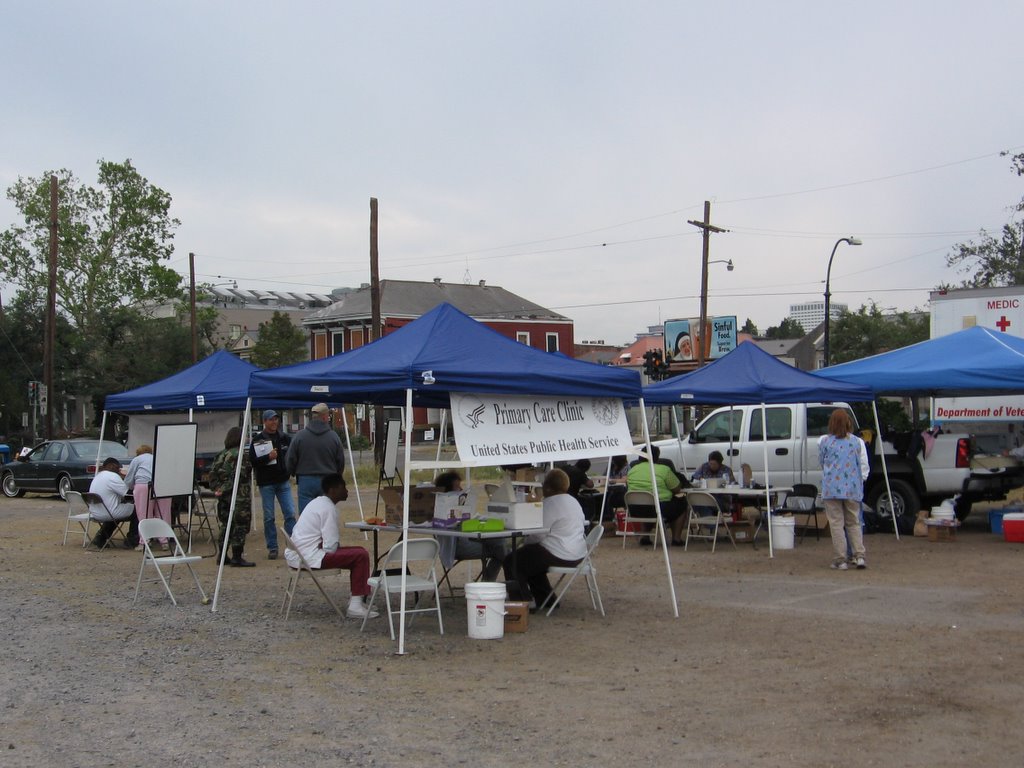
Driving along the edge of the French Quarter today I stumbled across a vacant lot at the corner of North Rampart and Esplanade streets that was filled with half a dozen tents. A large sign across the front of the property identified the site as a primary care clinic set up by the U.S. Public Health Service.

Five minutes later, I was sitting under one of the tents having my temperature and blood pressure checked. Then I was off to a second tent where a volunteer nurse from Iowa injected the second of the three B vaccine treatments into my right shoulder.

It was the her second volunteer trip to New Orleans since mid-September.

At other tents, people were getting flu shots, having their cholesterol checked and consulting with doctors about drugs and prescriptions.

The clinic was only at the French Quarter site for one day and was scheduled to relocate to the Convention Center on Monday.

I have until early March before I'll need the final shots for hepatitis A and B.
Given the short supply of doctors and operating hospitals in the city, makeshift clinics such as the one I visited have become essential.

Amazingly, I was in and out of the clinic with my shot in 10 minutes.

If only normal health care services operated with that kind of efficiency. I'll take a 10 minute wait under a tent over 50 minutes in a doctor's office any day.

Thursday, November 17, 2005

Self-imposed Chaos

It's a funny thing, life after the worst catastrophe in modern national history.

It makes you think . . . about everything. About your job, your friends, your relationships, your past, your future, your home, your finances, your past times, your theology, your politics, your passions, your fears. Have I left out anything?

Katrina stripped away the veneer of my life; the comfortable habits and motions that had lost their meaning and depth.

Removed, I was left with the naked truth. Unhappy at work. Unhappy at home. More than ready to take some big steps forwards.

So I disrupted what Katrina had left unscathed. The details are too long for here, but I'll boil it down. I turned down a job offer in Arizona and, instead, accepted an offer to move jobs at The Times-Picayune (the daily newspaper in New Orleans) to join our front line for covering the hurricane recovery story. On the homefront, I'll be moving on - literally - in the coming weeks.

Meanwhile, a brilliant new light from southern California is shining in my life. Just in time for winter, a nice fire to warm the heart.

A few people in the immediate weeks after the storm warned me against making any life-altering changes in the wake of such trauma.

But my gut soon told me differently, and my gut has never failed me.

So life in New Orleans is hard but good; it's frustrating but fulfilling; it's exhausting but energizing.

It's a city of contradictions. Funny, sounds like the old New Orleans. Maybe things aren't so different here afterall.

Posts on old blog

For the last two and a half months I've been chronicling my life in New Orleans after Hurricane Katrina.

I'll be posting here going forward, but my old posts will remain on the old site at KeithD.Blogster.com/

UPDATE: I've recreated all of my previous Katrina posts on this blog and back dated them so that they appear in proper chronological order.

Thursday, October 20, 2005

The losses continue

Driving home from work early tonight through the dead zone I noticed a big fire burning a few blocks off Elysian Field Boulevard and Claiborne Avenue.

I turned my car into the neighborhood of old shotgun double houses populated before Katrina by poor African Americans. The burning building was a church of a design fairly typical for the neighborhood. It was a fairly small red brick and wood building, single story, and capped in the front by a short, stout steeple.

By the time I arrived flames were shooting 10 feet to 15 feet from most of the building's roof. There were about six fire trucks positioned on the streets along the church's front and exposed side. Soldiers roamed the surrounding intersections but they had little to do since so few people were in the area. Only one soldier checked my press i.d. as I walked up to the scene.

I met Walt Philbin, a senior crime reporter for The Times-Picayune, who told me that the church was beyond saving by the time firefighters arrived. The firefighters were working to keep the flames from jumping to nearby homes. Walt couldn't say how the blaze started.

As we watched from a nearby corner the steeple exploded in flames, slowly tilted back then collapsed into the burning sanctuary.

It was terribly sad watching the church burn. A woman and child seemed to be the only people from the neighborhood watching the fire. The woman said she didn't attend the church, which was home to a Baptist congregation.

In many poor neighborhoods, small churches like this one are the centers of safety, stability and hope.

I wondered if anyone who went to the church knew yet that the building had survived the hurricane only to burn to the ground two months later.

Only a month and a half ago I had walked into my church on Esplanade Avenue to discover that it had been virtually untouched by the catastrophe that swirled outside its doors. I felt like I had reconnected with a dear old friend.

I can't imagine how members of the burning church will feel when they discover its fate.

Wednesday, October 19, 2005

Video of Times-Picayune evacuation from New Orleans

As New Orleans flooded, burned and descended into a hellish chaos in the wake of Hurricane Katrina on Tuesday, Oct. 30, staff members of The Times-Picayune who rode out the storm in the newspaper's downtown headquarters evacuated our flooding building.

We rode in the backs of about 10 newspaper delivery trucks through more than three feet of water to get out of the city, and then spent the next seven hours riding through congested and chaotic south Louisiana towns in 95-degree heat before arriving at our temporary home in Baton Rouge.

The New York Times chronicled the exodus in this article.


Here is the short video (accompanied by the song "New Orleans is Sinking," by Canadian rock band The Tragically Hip) that was filmed from the back of my truck as we departed the T.P. building through the flood waters.

The video opens with a view out of the office's front window as Katrina approached its climax outside. Listen for the haunting whistle that filled the building's front atrium throughout the worst of the storm.

About midway through the video, the camera pans inside the delivery truck to show its passengers. I'm sitting in the middle of the group with badly-thinning black hair and the short-sleeve blue shirt.You can download the original video here.

City still feels empty

People finally seem to be returning to my neighborhood in the Bywater section of New Orleans without moving vans.

Another four people on my block moved back into their homes this week, raising the total to about 10. That's still a housing unit occupancy rate of less than 50 percent for the block. No businesses have opened yet in our neighborhood. That's partly because many of them were looted or seriously damaged after Katrina.

Population seems to be the key to reviving parts of the city. The neighborhoods with the most residential activity seem to be the ones that suffered the least damage, contain a larger percentage of home owners rather than renters and have seen the speediest resurrection of businesses.

On my side of the city, about the only businesses that have opened are bars, gift shops and junk antique stores in the French Quarter, a small but growing number of restaurants and a handful of coffee shops. For the most part, nearly all of those businesses close their doors around 6 p.m. Nearly all of the restaurants close by 9 p.m. There's only one gas station open on my side of the city (and only five in the whole city), and only a couple of small corner grocery stores.
That makes even the simplest task, such as filling up the gas tank or picking up groceries for dinner, a real challenge.

We continue to avoid shopping in the suburbs because the store hours there are also limited and the shops are packed with people from open to close.

And just as I've feared for weeks, there are growing signs that the cost of living in the city is rising quickly.

Gasoline prices in metro New Orleans are the highest in the state, and wages, particularly near the bottom of the job market, continue to rise.

With little to do in the city and grocery store largely inaccessible, most of my money is spent on eating out. While a handful of re-opened restaurants have reinstated the prices that were in place before the storm, many others have raised prices - some substantially.

Constantine and I ate dinner the other night at a Decatur St. neighborhood spot that used to be a cheap eat place. We shared a large pizza (which is just big enough for two), a large regular salad and a couple of beers. Before Katrina this meal would have cost us about $30 before tip. On this recent night, the bill before tip was $43. The pizza alone was $18.

I'm afraid that our days of relatively cheap living in New Orleans, as compared to other cities of similar stature, are over.

That's troubling. Our traditionally low cost of living allowed working poor people to survive and made the city attractive to artists, musicians and young people. You take away those populations and you make New Orleans much more like a bland, middle-class suburb.

We've settled into our new routines for the most part, but that doesn't make them any easier or less depressing.

The most discouraging thing is not knowing how many more weeks, months or even years that life in New Orleans will be like this.

Meanwhile, every few days bring news of another friend or acquaintance who has decided to move away or stay where they evacuated. Those decisions anger some people who have returned to the city, but I can't really blame them. Why shouldn't people who had successful, happy, thriving lives try to re-establish that somewhere else if the prospect of having that life again in New Orleans in the foreseeable future appears to be nil?

Wednesday, October 12, 2005

Everyone should read this

Times-Picayune reporter Brian Thevenot was one of a handful of our staff members who stayed in New Orleans after the rest of the staff evacuated. He and the other staffers who remained risked their lives so that The Times-Picayune could continue publishing live reports from its home city.

His raw and riveting account of that time appeared recently in the American Journalism Review.
The article chronicles a heroic moment in The Times-Picayune's long history and a proud period for our often-besmirched profession.

My experiences recorded in this blog seem trivial in comparison.

Read Brian's first-person article here.

Monday, October 10, 2005

Back to work at my New Orleans office

I'm writing this post from my desk at The Times-Picayune headquarters building in downtown New Orleans.

About half of the staff repopulated the building today.

The other half is still in Baton Rouge at our temporary digs, or still evacuated.

I'm the only person from the Money section here, so it's kind of lonely in our part of the office. I can't wait for my co-workers to return tomorrow.

The atmosphere is pretty festive. Everyone hugging each other a lot. Lot's of food.

Looks like we have all of the comforts of work. Obviously, my Internet connection is on. The phones, including voicemail, are working normally. Even our in house email system is back up again.

And the second floor cafeteria has reopened. That's important, considering the scarcity of food in the city these days.

Our section of the newsroom flooded because we're right next to windows, so the carpet has been removed, exposing a bare sticky floor. And all of the desks and filing cabinets have been shuffled around. But it's still home, and it feels unbelievably fantastic to be back!!!!!

Word is that we're actually printing tomorrow's edition here tonight.

Just picked up my official storm t-shirt. On the front is The Times-Picayune masthead followed by this:
WE PUBLISH
COME HELL AND HIGH WATER

Enough said.

Time changes in New Orleans

A friend of mine now visiting Buenos Aries has commented about the late-night hours kept by local Argentines.

Dinner at 10 p.m., social gatherings at 11 p.m., late-night carousing until just before dawn. And sleeping hours stretching into the mid-day.

He doesn't realize it, but he's describing the New Orleans that I knew before Hurricane Katrina.
The Crescent City was one of the nation's few truly 24-hour cities.

My personal life clock typically ran this way during the week: Wake up around mid-morning; arrive at the office around 10 a.m.; home by 7 p.m.; dinner around 9:30 p.m.; in bed around midnight.

Mind you, I was considered an early bird compared to most of my neighbors.

That lifestyle was largely a result of the economy and the job market. With so many people working in the city's service and tourism industries, many kept late-shift work hours which gave them a life clock that ran about five or six hours later than the typical 9 to 5'er.

So far, the new New Orleans seems to be keeping time with the rest of the world.

Curfews, early business closing and limited work forces all have conspired to send those of us who have moved back home crawling between our sheets much earlier than normal.

Out-of-town workers, many of whom undoubtedly hail from the world of suburbia, also head for the doors at respectable hours.

It's strange to walk into a nearly empty restaurant or bar in the French Quarter at 10 p.m. and realize that you missed the evening rush by an hour.

Another contributing factor is exhaustion. After spending all day working longer-than-normal work hours or doing the hard physical labor required to repair storm damage around our homes, businesses and neighborhoods, we just don't have the energy to do much else.

Maybe this suburban-life schedule will be good for all of us, at least for the time being.

Maybe it was our late-night hours that kept us from dealing with and fixing so many of the problems that faced New Orleans before the storm.

Maybe through this new work ethic, we'll find the time to correct the city's ills in ways we only dreamed of before.

Whatever the case, I hope the change isn't permanent.

My experience always has been that the least interesting places on this planet always are the ones that roll up the carpets and turn out the lights by 10 p.m.

Sunday, October 09, 2005

Not so lucky afterall

Today was tough.

Constantine and I spent the morning clearing the debris and trash from the front of our house while a friend of ours took a chain saw to the back garden and cleared away a pair of fallen trees.

By 11 a.m., we were starving. A Salvation Army truck arrived just in time. You would have thought it was a truck carrying ice cream. The truck stopped in the middle of our block and within a couple of minutes there was a crowd of about 10 people around it from a few surrounding blocks. We each were given a hot lunch of beef stew, bread, rice crispies treat, Crunch chocolate bar and a bottle of water.

The tough stuff came after lunch when Constantine and I opened the bottom garage/storage area under the house and started cleaning.

Our house originally was built on the ground, but around the turn of the century it was raised about 12 feet, leaving a complete copy of the upstairs space underneath. We've always used the space for storage, but have planned to build the back half out as a spare guest apartment.

Until today, we thought only a little water had entered the bottom floor. But as we sifted though boxes, we quickly figured out that the water level must have reached more than a foot and a half.

We lost a lot of stuff, including boxes of personal records, books, albums, mementos from childhood and college, furniture, appliances still in their boxes that we had bought for the apartment, most of our camping equipment and a really nice home gym that we never got the chance to set up.

Nearly everything that got wet had mold on it. And the standing water that we found was slimy and putrid.

The hardest moment for me came when I found two particular boxes. One contained a few reminders of my days in high school marching band, including the hat I wore as a drum major - now damp and growing mold.

The other box contained all of my clips from my first two jobs. Since both of those jobs predated computerized newspaper libraries, the clips were my only record of my work during the first part of my career. Everything in the box was soaked and growing mold. I thought about trying to pull clips out and dry them, but I couldn't bear doing that. So I just quickly tossed the box into the growing mountain of trash in front of the house.

I feel silly feeling so badly about old stuff stored in boxes when I'm so lucky to have come out of this with my life largely intact. Still, it's frustrating to be feeling new losses six weekBlogger: ScoopZone - Create Posts after the storm hit. It sort of makes me think that I'll be going through this process over and over again for months to come.

A weekend in New Orleans

There's one thing I can say about life in New Orleans without any reservation: it's exhausting.
I'm stunned at how much there is to do even though my house largely escaped serious damage from Hurricane Katrina.

Still, the chores seem endless.

Our first task Saturday morning was getting our smelly refrigerator out of the house. That was no small job. Because of its size, we had to remove the doors and expose us and the house to the rotting stench still inside. We managed to get it onto the front porch, where it will sit until later today when we figure out how to get it down the narrow front stairs to the street.

Then we spent a few hours unpacking much of the clothes and personal items that we took on our evacuation. Though we made a big dent, several bags and plastic containers remain filled.

We spent some time cleaning and bleaching the kitchen and bathroom. Then took a break around mid-afternoon to drive across the Mississippi River to the West Bank.

We ate lunch at one of our favorite restaurants, a Vietnamese place called Nine Roses.

Amazingly, Nine Roses was serving its full menu. It was like eating at Galatoire's. Anna, the woman who owns the restaurant with her husband, told us she had assembled a partial restaurant crew from her old staff and from people who work at other Vietnamese and Chinese restaurants in the area that either have been destroyed or still haven't reopened.

She said that the close-knit nature of the Asian-American communities helped her overcome the severe labor shortage problems that have paralyzed so many other businesses in the area.
We went to Lowes to look at refrigerators and freezers. None are available on the floor. Orders must be placed and they arrive in two weeks. Delivery service is available but there is a one-and-a-half-month wait.

We looked at models on the computer there and decided to take measurements in the kitchen before placing an order.

Returning to the city from the West Bank was a relief. The suburbs are pretty miserable, much like Baton Rouge. They're crowded with traffic. The stores are filled with people. Everything closes by 5 p.m. or 6 p.m.

We spent the rest of the day helping a couple of neighbors turn on their natural gas, powering up our hot water heater and transferring about five bags of putrid, rotten refrigerator garbage piled near the front of our house into heavy-duty, contractor strength black garbage bags.

I saw things in that garbage that I've never seen before. It took everything I had not to throw up. I wore plastic gloves for the job, but by the time I finished I reeked from head to toe.

Today, we plan to start clearing the trees that fell in the back garden and cleaning out the downstairs. Now that we've had time to check things more closely, it's clear that we got about half a foot of water in the back half of the downstairs floor, which we use for storage. We think the water came from rain flooding in the backs of the houses.

I'm felt more exhausted than I have since before the storm. Certainly, it's partly because I'm doing more physical work. But I think it's also because I'm feeling more relaxed now that I'm home. The adrenaline has finally subsided and my body is finally starting to rest.

I can't imagine how hard the work must be for people who suffered major damage to their homes.

We're up to six neighbors who have moved back to our block. All of them, including two renters, say they're staying. That's great news!

Soldiers drive down our block on a regular basis day and night. I've never felt safer in the city.
I saw a parrot fly over the house late yesterday afternoon. I'm so happy they are still here. A load of green parrots escaped from the airport about 15 years ago, and they have slowly populated the city since.

A flock began appearing a couple of years in our neighborhood, and it had grown to about 30 birds by this summer. I've been hoping they would come back.

Friday, October 07, 2005

$6,000 bonus for flipping burgers

Some strange things are happening in the New Orleans economy.

If you want to see how strange, check out my article in today's online version of The Times-Picayune here.

It's about fast-food restaurants that are having a hard time finding staff to reopen local stores. To compete, they are shooting up wages and offering things like signing bonuses for workers willing to stick around for the next 12 months. That's right signing bonuses, for burger flippers!

Higher consumer prices can't be far behind.

Look for the article titled, "Fast-food restaurants hungry for workers."