Showing posts with label Katrina. Show all posts

Wednesday, September 24, 2008

Cajun Country

I keep telling my friends in SoCal that my passion for LSU doesn't compare to the devotion that many other fans display here in southern Louisiana. Maybe this roadside memorial to a Tiger fan who died in a car crash finally proves the point.
I found the memorial as I rode with my parents to Abbeville in the heart of Acadiana.
No self-respecting Tiger tailgater would be without this spice mix available at Richards Meat Market in downtown Abbeville.
It took all of my will power to resist buying one of the bags of fried pork rinds sitting on top of the display case on the right.
The parental units and I enjoyed gumbo and fried seafood at a cafe down the road.
The main reason for the day trip was to visit with 94-year-old great aunt, Sr. Margaret Mary. She's a nun who's been an unapologetic liberal as long as I can remember. We really got to know each other when we both lived in New Orleans in the 1990s and early 2000s, and she was thrilled when I came out to her.Back to all things LSU. This is my college buddy John posing next to a few of the items commonly spotted under car ports in Baton Rouge.

Tuesday, September 23, 2008

NOLA parting shots

Is there any doubt that I had a great time returning to New Orleans for the first time in two years, hanging out in my old haunts and communing with long-lost friends and workmates?
The palm trees are back on Canal Street and they're looking better than ever. Katrina shredded the original palms that had been planted along the street's neutral ground (that's median to you non-New Orleanians). Those have been replaced, and they've been joined by more trees lining the sidewalks. The added greenery really dresses up the street.

This was one of those only-in-New-Orleans moments. While strolling down Bourbon Street in the afternoon, I stumbled across this bin filled with a freakishly large number of Mardi Gras king cake babies.
Why were they there? Who did they belong to? What could it mean? These questions will haunt me forever.
Painted miniature street cars like this one seem to randomly pop up around town. They must be a local version of Chicago's much-copied painted cows.
I actually miss this.

No trip to Nola is complete without a Saturday night stop at Cafe Lafitte's, the city's oldest gay bar which bills itself as the "Daddy of 'em all." That's (left to right) Tommy, Pedro and Fred in the center and Lyle and Galt on the right.

I also got to see the gang at my old newspaper, The Times-Picayune, but my only photo with some of my former colleagues in the business section was out of focus. From left to right are Kim, business editor; reporter Kate; reporter Jaquetta; and reporter Jen.

We're gathered in front of my former desk, which for nine years offered me a view of the Broad Street overpass through opaque, bullet-proof glass.

Kim and I rode Katrina out together in this office space with two other business section co-workers. Good times!
I may be gone from the media bunker on Howard Avenue, but these pics prove that I'm not forgotten.

Metro reporter Gwen (left) snatched this "Geaux Tigers" sign from my old desk and mounted it on her cubicle. On the right is a snapshot of me at my San Diego office, taken by Jaquetta during her trip out West last year, that hangs on a message board inside the business section office.
Here are some of the SEVEN iPhones that were part of our weekend gathering. Lyle, who is an Apple employee and helped test the device, was thrilled, and he promised to tell Steve Jobs all about us when he returns to work.

TODAY'S BLOG SPOT:
The dinning room of McDonald's in Jennings. I worked as a cashier at this store in the early 1980s when I was in high school. It's had a complete coffee-shop makeover in recent years.
It seems to be home to
the only public wi-fi hotspot in town. The service is through AT&T, and a day pass costs $2.95.

Monday, September 22, 2008

Recovery tour

Matt took us on a whirlwind tour of East New Orleans, Chalmette, the Lower 9th Ward, Gentilly and Lakeview - the areas damaged most by flooding after Katrina and struggling the most to recover from the disaster.
These are some of the houses being built in the Lower 9th by Brad Pitt's Make it Right Foundation. They look nice, environmentally friendly and more storm proof than the buildings that were previously here, but I don't know what this aesthetic has to do with the people, neighborhood and culture that existed in this location before Katrina.Most of the Lower 9th looks just as it did a few months after the storm when all of the debris was carted away.

The first of what likely will be several Katrina memorials sits along one of the Lower 9th's major thoroughfares. The red structure represents the ruins of a house and the blue columns depict the rising water levels during the flood.
On the west side of the Industrial Canal in the Upper 9th Ward, Habitat for Humanity is getting it right at the Musician Village, a cluster of historically and culturally accurate homes built for the city's displaced singers and band members. These pics show both sides of the same street.

I can't imagine what it's like to walk out the front door of your house every day and see empty overgrown lots and gutted abandoned houses across the road. I suppose you just get blind to it after a while, sort of like the way I dealt with the city's horrendous crime problem and decayed neighborhoods when I lived here.
These is the massive new pumping system constructed by the Army Corps of Engineers at the mouth of the London Street Canal, one of the waterways that burst through its levees during Katrina.Back in Chalmette, it was great to see that Rocky & Carlo's was open again, and that the "ladies" are still welcome. The restaurant is still serving up a classic Yat cuisine, including macaroni and cheese smothered in red or brown gravy and wop salad.
Returning to the scene of the crime

One of our first stops in NOLA was the office of New Orleans Publishing Group in the Heritage Plaza Building along the Metairie side of the 17th Street Canal (yes, THAT 17th Street Canal).

We were joined by Julie Bernard (on left), one of only four people remaining at NOPG who date back to our tenure in the mid-1990s.
We found a copy of the 15th anniversary edition of New Orleans CityBusiness in Julie's office. We all worked on that edition, and the back pages featured photos of the staff. I'm standing in the back right corner in this shot.
This was my view from my cubicle on the top floor of the building. That's the 17th Street Canal on the left - the levee break during Hurricane Katrina came near it's end in the upper-left corner of the pic. Everything to the right of the canal was flooded and destroyed.

If you look really hard at the upper center of the pic on the right, you'll see New Orleans' Central Business District. I loved watching clusters of pelicans fly in formation along the canal in the afternoon and CBD glass skyscrapers explode in a burst of orange during sunsets in the fall.

Apparently, a trip to Heritage Plaza wouldn't be complete without a stop at the drive-thru daiquiri shop a few blocks away. In Louisiana, carrying a daiquiri in a car is legal as long as the lid is on the top of the cup and a straw is on the side.

Monday, May 12, 2008

More West Coast Cajuns

The best part of our trip to Berkeley was spending time with Greg and Rod, old friends of mine from New Orleans who moved to S.F. a year and a half ago.

I hadn't seen them since two weeks before Katrina, when we got together for dinner at their house in New Orleans.

They were great tour guides and taxied us around in their hot oh-so-California hybrid car.
It was great reconnecting with them and seeing how happy they are with their new lives in San Francisco.

Tuesday, January 03, 2006

No Escape

Rex and I headed east to Pensacola, Fla., for a two-day road trip seeking solace from the humdrum of post-hurricane New Orleans. We thought some walks along the largely-deserted beach would offer a nice break from the garbage piles, empty buildings and abandoned cars still filling much of the Crescent City.

Boy were we wrong.

About 15 months after Hurricane Ivan battered the Florida Panhandle, Pensacola Beach still wears oozing scars from its encounter with the terrible cyclone. The empty beachside condominium building, shown above, sat near our motel. There were dozens more like it up and down the beach.


The biggest surprise was the countless tracts of vacant property that, before Ivan, held an ever increasingly dense pack of shops, hotels and homes. The beautiful sand dunes are all gone, and vehicle access to the island's more pristine western side remains blocked.

It turned out that reminders of Katrina were lurking right under, well actually above, our noses.

The top floor of our motel was populated by Louisiana and Mississippi Gulf Coast evacuees who had lost their homes four months ago. Some of the evacuees had even decorated for the holidays.

The motel manager told us that 30 rooms remain occupied by Katrina victims.

I spoke to another local who blamed the beach's delayed recovery on slow actions by insurance companies.

The whole experience left me feeling even more discouraged about the pace of recovery in New Orleans.

Still, a walk along Pensacola's beautiful beach did remind me that Mother Nature, and us humans for that matter, are capable of remarkable resilience.

Sunday, January 01, 2006

When is a straight bar NOT a straight bar?

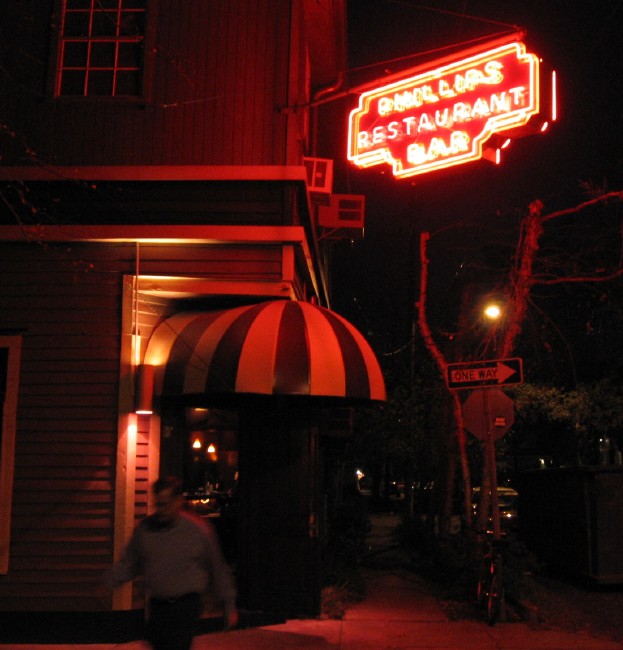
Here's more proof that the gay community in New Orleans is bouncing back from the hurricane. We spent Friday night hanging out with a few friends at Phillip's Bar and Restaurant, located on the corner of Maple and Cherokee streets in the Uptown neighborhood.

Though ostensibly straight, Phillip's had developed a loyal Friday night gay clientele before the storm.

By 7:30 p.m., when we were there, the crowd numbered about 70 - mostly guys apparently of the same persuasion as me and Rex. Want proof the crowd was mostly gay? No one seemed to notice the hot, young female babes working the bar except for a married buddy of mine. And we seemed to be the only ones paying attention to the Peach Bowl football game featuring LSU and Miami that was playing on the projection screen television.

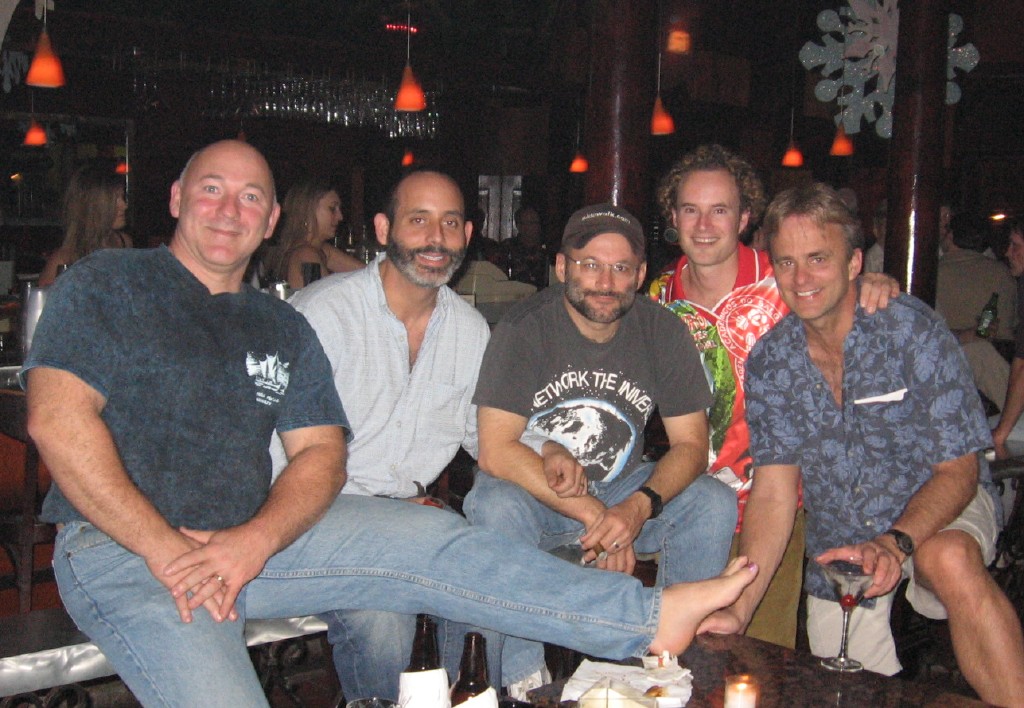
Me and buddies at Phillip's Bar and Restaurant in Uptown New Orleans.

By 10 p.m., the gay crowd had thinned substantially, only to be replaced by the type of college crowd one would normally expect to find at a bar and grill within walking distance of the Uptown universities.

Phillip's was nice enough, and everyone - gay and straight - seemed comfortable. But the long martini list, oversized snow flakes hanging from the ceiling and other details made the place a little too foofy for my taste.

Thursday, December 29, 2005

Art, Used Cars and Trailer Trash

There's a set of railroad tracks flanked by empty lots about two blocks from where I live. One of the lots is Nero's favorite poo spot. Before Kartina, the tree line along that lot was a well used illegal dumping ground for locals.

It wasn't unusual during a morning walk with the little black pug to discover a newly discarded item or two flung into the brush, maybe even a bulging black trash bag.

After Katrina, the area became one of many "official" unofficial trash heaps. I even dumped a pile of garden debris and flooded stuff from the garage onto one of the piles. We really had no choice. For more than a month, there was no streetside trash pickup. Hauling waste to the tracks was the only way to keep the stuff from stinking up the fronts of our houses.

The big piles have disappeared, but every few days new items show up again. I discovered the above pile while driving to work this week. I imagine it could be the creation of one of the eccentric artists who populate the Bywater neighborhood where I live. It spoke to me.

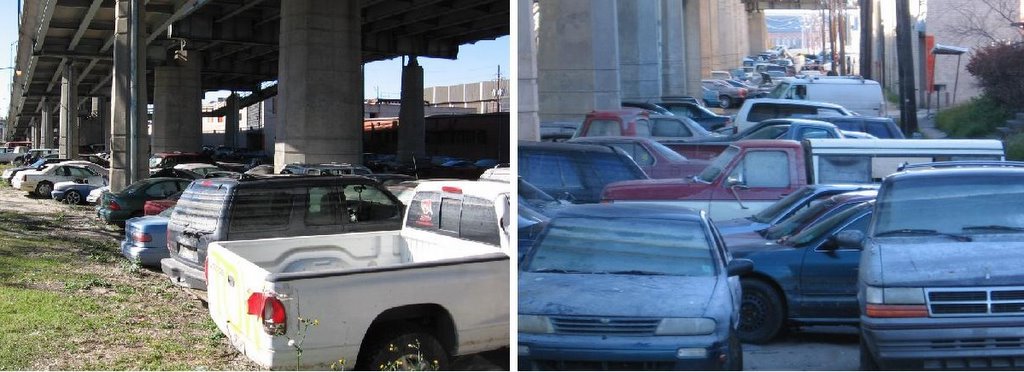
No art here. This is the scene below the Broad Street overpass next to my office. This space used to be overflow parking for newspaper employees. It's become a graveyard for flooded wrecks (note the water lines on the windows). Sometimes, some of the cars disappear. But within a few days, the lot is full again. Who knows when it will end.

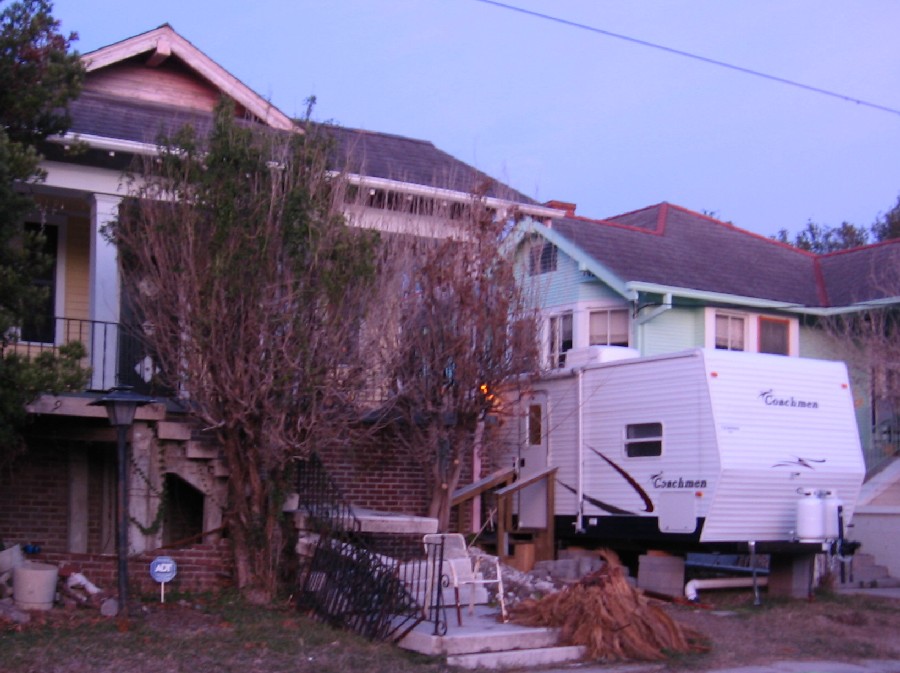
I drove a few blocks through the Fontainebleau neighborhood near the center of the city the other day and counted more than 20 FEMA trailers, such as this one, in front of houses.

Not so long ago, I would have hurled at the sight of a trailer in a historic neighborhood. But the spread of mobile homes is heartening. They're a sign of change after months of stagnation, a signal that people finally are coming back to flooded sections of the city. Welcome to New Orleans - the nation's biggest trailer park!

Wednesday, December 21, 2005

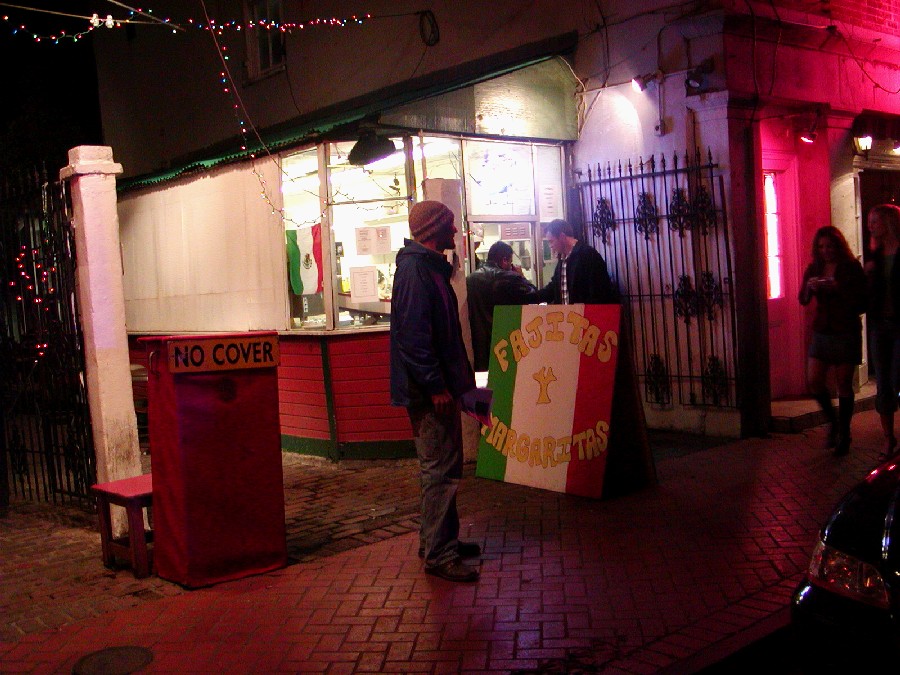
México en el Calle Borbón


How about a tamale or a fish taco to go with your Pat O'Brien's Hurricane or Big Ass beer?

Welcome to Fajitas y Margaritas, one of the newest tenants to move onto Bourbon Street after Hurricane K. Located in the heart of the French Quarter, the sidewalk kitchen is just a couple of doors down from Big Daddy's, the strip club best known for the pair of mannequin legs swinging from the front window.

I discovered this joint Wednesday night during a two-hour stroll up and down Bourbon Street.

You can't find a Lucky Dog cart selling hot dogs on Bourbon Street to save your life, but an $8 burrito is just around the corner.

Ethnic food, outside of pseudo-Cajun cuisine stereotyped to the hilt for the most indiscriminating tourist palate, has been traditionally hard to find along New Orleans' main tourist strip. That makes Fajitas y Margaritas all the more remarkable.

At the very least, the shop boldly declares the arrival of the city's newest immigrant population.

Tuesday, December 13, 2005

Gay life in N.O.

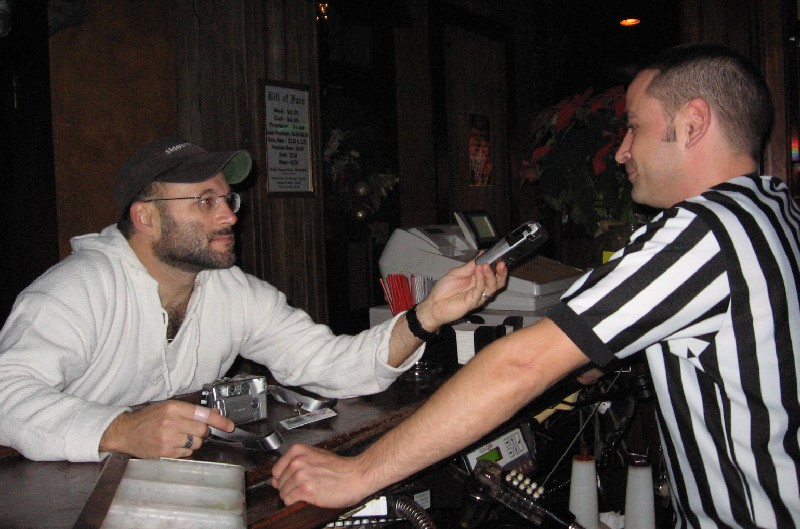
How many gay men does it take to keep a Bourbon Street bar open? Well, as Rex and I found out late Sunday night, not nearly as many as you might think. The crowds were fairly small everywhere we went - Cafe Lafitte's in Exile, The Pub, Good Friends and Rawhide. But that's not so unusual for December, traditionally the slowest month for convention business.

Rex did interviews with bartenders for a story that he's working on about the resurrection of gay and lesbian life in the Big Easy. If there was a universal theme in the interviews, it was this: government workers and contractors now filling the bulk of the city's hotel rooms don't spend nearly as much money on watered-down, overpriced beverages as do tourists.

Saturday, December 10, 2005

Lowa Nint Wawd

The neighborhood worst-hit by Hurricane K lived up to its billing, and then some.

After more than eight weeks back at home in New Orleans, we ventured for the first time into the Lower 9th Ward Saturday afternoon. We crossed the Industrial Canal just a few blocks from my house in the Bywater neighborhood then turned north.

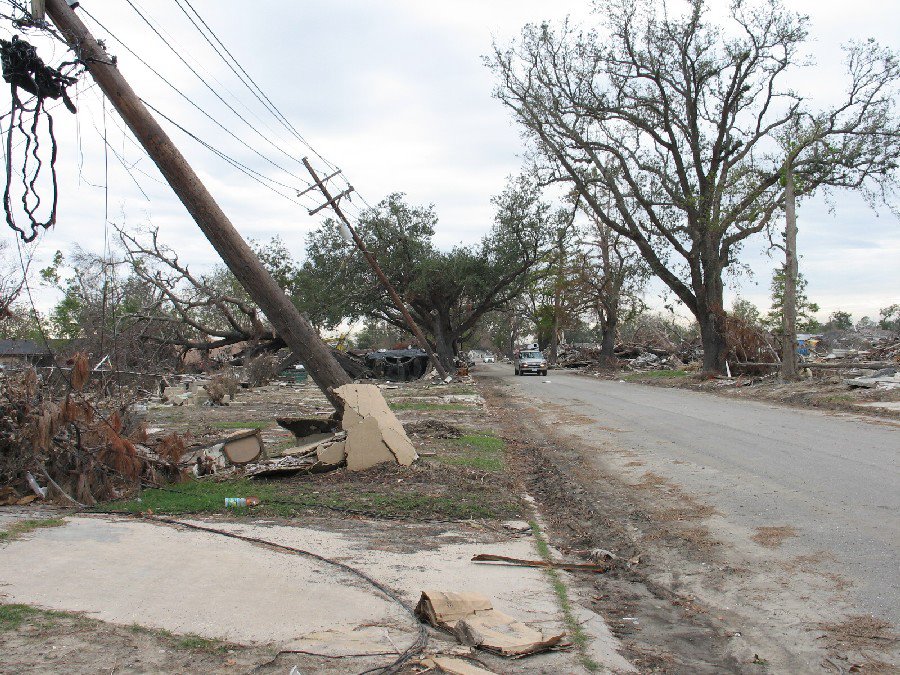
Before long, we were in the middle of a vast wasteland stretching more than 100 city blocks in all directions. Everywhere we looked were empty foundations where houses once stood, cars tossed around like toys, towering piles of rubble and a ubiquitous blanket of gray dried mud.

More than three months after the storm, the only signs of life there were the other catastrophe tourists cruising the area and a handful of people sifting through the wreckage of their homes.

We got an up-close look at the mammoth barge that rested on the neighborhood side of the levee after floating through the barrier during the early hours of Katrina.

I expected things to be bad, but the reality was beyond imagination. I won't be making a return trip anytime soon.

Top pic: The force of the flood water from the Industrial Canal (off camera about four blocks to the right) pushed everything in its path the other way, creating a vertigo effect along some streets.

Sunday, December 04, 2005

Where's Anderson Cooper when you need him?

I spent Sunday morning second-lining down Esplanade Avenue to St. Anna's Episcopal Church with fellow parishioners and visiting priests and parishioners from about half a dozen other Episcopal churches outside of Louisiana. Leading the procession were the Storyville Stompers who reunited several weeks ago and began playing gigs again. A jazz mass followed at the church.

The visitors kept repeating throughout the weekend that the vast scope of damage in the flooded areas of the city was beyond anything they perceived through television and newspaper reports back home.

That's the same response that Rex gave a few days ago when I took him riding through the Lakeview neighborhood near the 17th Street Canal breach. He was stunned.
I've grown surprisingly accustomed to the reaction.

It's sort of like telling visitors they can carry cups of their favorite alcoholic beverage in the street without fear of police intervention. To them, it's an unbelievable privilege not enjoyed at home. To us New Orlenians, it's normal.

That's kind of how it feels now to live a few blocks from the Dead Zone. What shocks the visitor is just life in New Orleans to the rest of us.

Tuesday, November 22, 2005

Welcome to Baghdad, USA

Four overnight power outages in two weeks. One morning without water. A day and a half without cable television and high-speed Internet service. Periodic whiffs of natural gas around the neighborhood.

We used to joke that life in New Orleans was like living in the Third World, a reference to our corrupt and greed-driven political system.
It's not a joke anymore.

It's bad enough to have to drive 15 minutes in the middle of an urban area to find an open grocery store. It's bad enough to get mail delivered once or twice a week, if you're lucky. It's bad enough to eat dinner by 8 p.m. because most restaurants close by 9 p.m. It's bad enough to encounter shoulder-high piles of debris practically everywhere you go. It's bad enough not knowing when, or if, the garbage truck will pass.
But the utility problems take the frustration of living in a disaster zone to an entirely different level. Each time some service goes out, it feels like a sharp kick in the gut. Remember we're nearly three months past Hurricane Katrina's disasterous romp through the city.

Granted, the services haven't stayed off for very long. The power always comes back on within a few hours after sunrise, when it's safe for utility workers to venture into the still black dead zones of the city to flip breakers that sporadically trip along the limited number of feeder lines connecting repopulated neighborhoods to functioning substations. The water was back on within a few hours of going dry. And with any luck, I'll have the International History Channel glowing from from my living room screen tonight.

Still, if I had wanted to live in Baghdad I would have enlisted in the Army.

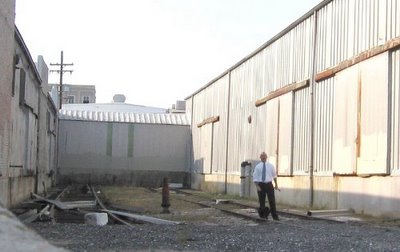
Pic: Me and Nero standing between a pair of abandoned, storm-damaged warehouses a block and a half from the house.